
The very existence of PSBs in Bosnia has been put into question recently due to extreme financial hardship and an inability to agree on a functional funding model. Revenues of the PSBs (consisting of a monthly license fee levied on all households, advertising revenues and income from other sources such as rental of equipment to other media outlets) have been decreasing across the board. For example, the annual report of BHRT for 2015 indicates a decrease of 27% in marketing revenues, and a drop in income from license fees from 11.23 million EUR to 10.37 million EUR in comparison to 2014.[124] Similarly, the RTRS report for 2014 shows that in comparison to 2013, advertising income fell from 2 million EUR to 1.7 million EUR while income from license fees fell much more considerably, from 7.7 million EUR in 2013 to 5.95 million EUR in 2014.[125] RTRS depends on funding from the Government of Republika Srpska to make up for its losses.[126] In 2015 alone, 153,387 EUR was allocated to RTRS from the budgetary reserves.[127]
BHRT and RTVFBiH have been heavily indebted since at least 2011.[128] While BHRT has managed to pay some of its debt to the European Broadcasting Union, it remains high at €5,254,701.20.[129] After announcing in mid-2016 that it may shut down due to EBU debts and high running costs, the EBU prolonged the debt payment, though no information was presented to the public.[130] However, BHRT minimized its programming to an informative program and a sports program. In the meantime, the Parliament discussed possible solutions for the subscription fee collection, which was seen by the BHRT as the first signal of change.[131] When it comes to RTVFBiH, no recent data are available. However, the absence of published annual financial reports since 2012 is not reassuring.
4.2.1 Roots of the Funding Problem
The roots of the problem can be traced back to four underlying causes. The first is the legal provision that defines how advertising revenues are to be divided among the three broadcasters. The second cause of the crisis is a broken model of collection of the monthly license fee. The third problem is inadequate management, which has failed to address problems of excessive costs and inadequate revenues. The fourth problem is the political interests that attempt to profit from the prolonged financial crisis in order to obtain concessions for their political goals in exchange for supporting a particular solution. In the following paragraphs we will provide a brief analysis of each of these five underlying problems, which will help shed light on the current financial hardship of the PSB in BiH.
The redistribution of income among the three broadcasters which was envisioned by the legal framework (PSB System Laws) simply doesn’t occur in practice. The laws stipulate that 50% of advertising revenues and license fee income will be allocated to BHRT, while 25% will belong to each entity broadcaster: RTVFBiH and RTRS. The purpose of such a solution was twofold: to provide a financial boost for the country-wide BHRT and to create a strong mechanism for the integration of the three broadcasters into a unified PSB system. However, the problem with the formula is especially prominent with regard to the distribution of advertising income. Namely, there is a huge disparity between the three broadcasters when it comes to the collection of advertising revenues (Figure 2) – RTVFBiH earns around 60% of all advertising revenues, and yet it is supposed to keep only 25%, while BHRT, which earns around 15%, is supposed to get 50% of advertising revenues, and RTRS, which earns around 15%, is supposed to get 25% of total advertising revenues.[132]

Figure 1 Envisaged distribution of marketing revenues among PSBs.[133]
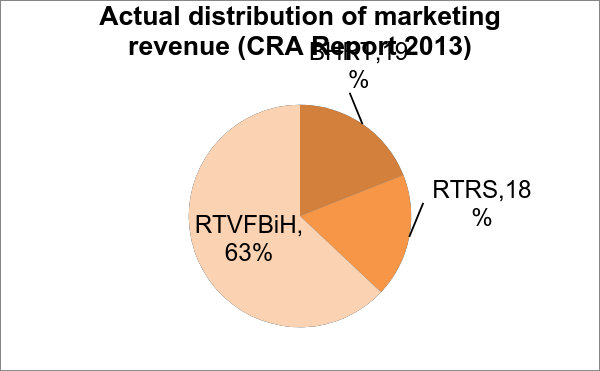
Figure 2 Real distribution of marketing revenues among PSBs.[134]
The failure to establish the joint Corporation, which would be in charge of collection and distribution of the license fee and the advertising revenues and the management of facilities and equipment, means that there are no mechanisms for proper collection and management of PSB revenues. As a result of varied advertising revenues, RTVFBiH naturally pushes back on creating the Corporation, which would redistribute its high marketing revenues to the other PSBs. RTRS would like to keep its marketing revenues but also get some of the redistributed license fees collected by FTV. Thus the opposition to creating the redistribution key comes from the entity broadcasters themselves, who naturally do not wish their commercial successes to go towards funding for BHRT or other PSBs performing less well.
Table 1: Advertising Revenues by PSB[135]
|
Public Broadcaster |
Advertising Income (EUR) (year of last available data) |
|
BHT |
1,538,958.57 (2015) |
|
FTV |
6,296,792.49 (2012) |
|
RTRS |
1,745,802.81 (2014) |
The second problem has to do with the inability to collect license fees at a sustainable level. Namely, PSBs in BiH are funded by license fees collected via landline telephone bills, a model that officially expired in June 2016,[136] and a draft law to adopt the European model of funding of direct taxation has yet to be voted on.[137] However, collection of license fees had been dropping radically prior to 2016.[138] The inability to collect license fees was caused by the majority of the population switching to mobile phones, inefficiency in the collection of fees, and boycotts of these fees led by various political parties.[139] The system of license fee collection was installed as a temporary system nearly a decade ago, but never reformed due to a lack of consensus on the part of political parties and individual broadcasters. In the meantime, the Parliament discussed possible solutions for the subscription fee collection, which was seen by the BHRT as the first signal of change.[140]
Another crucial problem is inadequate management which is unable or unwilling to undertake the necessary reforms of the PSB system. PSBs incur unnecessarily high fixed costs, and often have a surplus workforce, something which is especially salient at BHRT. Many of these surplus workers are believed to have been “employed in line with political or personal connections,” and a lack of transparency about outsourced production has given rise to rumors of corruption.[141] Some argue that a reorganization of the entire system ought to have been made a long time ago, and that the system is gigantic, with too many directors and editors, and little accountability.[142] The bloated workforce is often the subject of complaint. In total, in 2012, there were 1,850 people employed in the PSB system,[143] while in 2015 BHRT’s highest expense was the salaries of its 875 employees – 49% of its total expenses.[144] Another serious failure of management relates to the lack of transparency of finances. A financial report for 2015 is only available for BHRT, the latest report for RTRS is for the year 2014, while RTVFBiH’s last report dates back to 2011. A lack of transparency about outsourced production, for example, has given rise to rumors of corruption: “all three companies developed the habit of outsourcing much of the production to private companies, although they had ample capacity to do the job themselves. This became one of the favorite ways of redirecting the funds to the pockets of the managers and their close friends.”[145] Audits of financial reports of public service broadcasters identify irregularities while entity governments often refuse to accept the findings of the audits.[146] There are no mechanisms “to ensure that government funding for the media in BiH is legitimate, transparent and in the service of public interest…no specific decision-making body on media subsidies exists, and such funding can easily be misused for particular political and business benefits.”[147] Additionally, the PSBs regularly fail to incorporate the recommendations from the negative financial audits by the state.[148] In 2013, the Audit Report for FTV pointed out issues in the financial functioning of this broadcaster such as “lack of respect for procurement procedures, unjustifiable discounts in advertising contracts with two advertising agencies,”[149] etc. Moreover, there is an explicit criticism of the management of PSBs by the CRA regarding their failure to use effectively all available means to increase collection of the license fee.[150]
None of the above funding problems could have persisted for such a long time had there not been strong political interests in their perpetuation. Namely, there is a continuous boycott of payment of the license fee by leading politicians, most notably among the Bosnian Croat political leadership, but also in the RS.[151] Leading Croat politicians have used non-payment of the license fee as a means to achieve their objective of introducing the separate Croat language channel within RTVFBiH – a request strongly opposed by the Bosniak political leadership as well as by a large part of the public and the academic community. The inability to pass an adequate legal framework to replace the now obsolete model of collection of license fees and the resulting near-collapse of BHRT has been deemed by the European Broadcasting Union as in direct contravention of the protocols for BiH’s EU accession.[152] The Amsterdam Treaty considers the system of public broadcasting as “directly related to the democratic, social and cultural needs of each society” and states that countries acceding to the EU must “provide for the funding of public service broadcasting … for the fulfilment of the public service remit.”[153]
Ultimately, financial instability is a major factor leading to the compromised independence of the PSBs in BiH. In the RS, a recently passed amendment to the RTV law[154] allowed RTRS to seek budget funds from the entity government if it came up short, though critics argue that this may result in increased control over the broadcaster. Some see this as an attempt to ‘emancipate’ RTRS from the national broadcasting system completely,[155] though it could also be interpreted as a survival mechanism in the face of financial crisis. The general editor of RTRS claimed that RTRS is “the only completely stable public broadcaster in BiH,” citing their lack of debts and a new headquarters.[156] However, this stability is mainly due to the fact that their losses (which have been documented in their own reports) are made up for by the government. Media scholars worry that government funding can lead to too much direct control over media. In the case of RTRS, a media analyst disagreed with the editor’s claim that financial stability was the most important criterion for sustainable PSB. He claimed that looking at RTRS, it was clear that their financial stability has not resulted in “quality reporting, proper functioning, let alone independence in reporting.”[157] Links between control and government funding can be seen in the Federation in the case of government-funded local broadcasters on a cantonal and municipal level, as well as the direct funding of two entity news agencies, SRNA and FENA, which has led to a “grip of government over the media sector.”[158]